
Diamond Cut
Gym Workout for Fat Loss, 4 Days a Week
A diamond cutter brings out a stone facet by facet, with many short, precise passes. “Diamond Cut” makes four such passes a week: short full-body workouts, 90 seconds of rest, and sets that finish close to failure toward the end of each stage. Set aside four days and start with the intro week.
- GoalFat Burning
- LevelExperienced
- WhereGym
- Workouts48
- One workout~46 min
- ForEveryone
Who it’s for
- You have some gym experience
- You want to get leaner
- You can train four times a week
How it works
- 014 workouts a week, 6 exercises each, all full body; 16 sets a week for chest and 15 each for back and legs
- 02Reps: in Base, compound lifts for 12 and isolation exercises for 15; in Build and Peak, 10 and 13; abs for 20
- 03Three 4-week stages: in Base the load rises week by week, in Build it moves in a wave with a step back in week 3, in Peak it drops in week 4
- 0490 seconds of rest between sets, and the exercises stay the same across all three stages
Keeping the load up in a calorie deficit
Four full-body workouts load chest, back and legs four times a week, and the large weekly volume is split into short sessions. Rest between sets is 90 seconds. Toward the end of each stage, sets finish close to failure.
Weekly volume
Counts sets where the muscle is the main target of the exercise
- Chest16 sets4 workouts
- Back15 sets4 workouts
- Shoulders9 sets3 workouts
- Quads9 sets3 workouts
- Arms9 sets3 workouts
- Abs8 sets3 workouts
- Hamstrings & glutes6 sets2 workouts
In the Base stage, some sets go to failure
What the research shows
4In a calorie deficit, muscle gain slows down while strength holds
Murphy et al., 2022Training a muscle twice a week produces more growth than once a week
Schoenfeld et al., 2016The closer a set ends to failure, the more muscle growth; the link with strength is weak
Robinson et al., 2024Resting longer than a minute between sets gives a small edge in muscle growth
Singer et al., 2024
Body fat is set by your diet; the program sets the training load.
Workout A
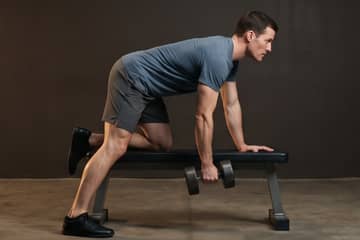
6 exercises · ~46 minThe whole first workout. Tap an exercise to open its technique with photos and video.





All workouts in the program
48 sessions over ~11 weeks, 4–5 per week. Workouts A, B, C and D repeat in a loop, 12 times each. The other workouts and the weight for every set are in the app.
Workout intensity
The load of each session: higher means harder. average per round A–D
Workout number
Program weights — from your 1RM
1RM is the weight you can lift once. Enter it for the base exercises and AtletIQ will calculate working weights for all 48 workouts of “Diamond Cut”.
- The weight of every set comes from your 1RM
- All workouts of the program in order, with rest between sets
- Progress for every exercise
| Workout | Weight | Sets × reps |
|---|---|---|
| 1 | 35.5 kg | 3 × 10 |
| 2 | 40 kg | 3 × 8 |
| 3 | 33 kg | 4 × 12 |