Upper Body Workout at the Gym, with Dumbbells or at Home
Pick where you train and your level: at the gym, at home with dumbbells or at home with no equipment. You get an upper body workout with sets, reps and rest times, with presses and rows in turn for the chest, back, shoulders and arms. Below are exercises for these muscles with video and technique.
In short
An upper body workout combines presses and rows in turn for the chest, back, shoulders, biceps and triceps. At the gym and at home with dumbbells it is 6 exercises, at home with no equipment 4. A beginner does 3 sets of 10–12 reps. The estimated time with the upper-body warm-up is 25 to 50 minutes.
AtletIQ · Upper Body Workout at the Gym, with Dumbbells or at Home · At the gym · Beginner · atletiq.com/en/exercises/upper-body/
Estimated time
about40minutes
6 exercises in the main part plus a warm-up of about 5 minutes.
- Total 18 sets
- Set ≈40 sec
Go down the list from top to bottom. In “3 × 10–12” the first number is sets and the second is reps per set. Rest between sets for the time shown.
Warm-up of about 5 minutes
Main part6 exercises
-
1
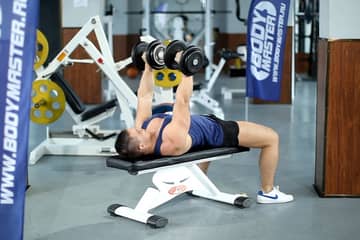 Dumbbell Bench PressHorizontal press · Chest
3 × 10–12rest 90 sec
Dumbbell Bench PressHorizontal press · Chest
3 × 10–12rest 90 sec
-
2
 Seated Cable RowsHorizontal row · Middle Back
3 × 10–12rest 90 sec
Seated Cable RowsHorizontal row · Middle Back
3 × 10–12rest 90 sec
-
3
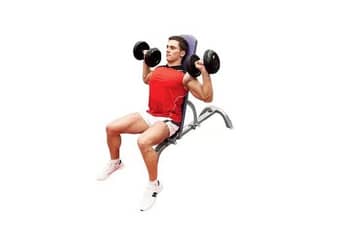 Dumbbell Shoulder PressOverhead press · Shoulders
3 × 10–12rest 90 sec
Dumbbell Shoulder PressOverhead press · Shoulders
3 × 10–12rest 90 sec
-
4
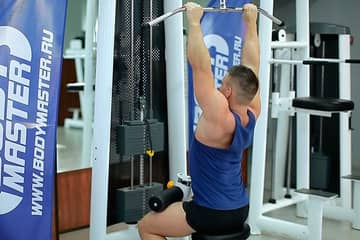 Close-Grip Front Lat PulldownVertical pull · Lats
3 × 10–12rest 90 sec
Close-Grip Front Lat PulldownVertical pull · Lats
3 × 10–12rest 90 sec
-
5
 Hammer CurlsBiceps
3 × 10–12rest 60 sec
Hammer CurlsBiceps
3 × 10–12rest 60 sec
-
6
 Triceps PushdownTriceps
3 × 10–12rest 60 sec
Triceps PushdownTriceps
3 × 10–12rest 60 sec
Exercises by upper body muscle
Bench presses, flyes and push-ups
Pull-ups and pulldowns and rows to the waist
Standing and seated presses, lateral raises
Barbell and dumbbell curls, hammer curls
Cable pushdowns, French presses and dips
Popular upper body exercises
24 exercises
-
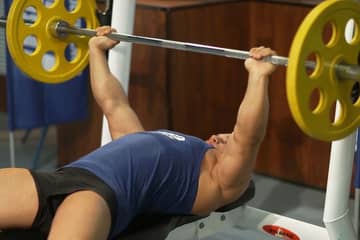 Video Barbell Bench Press — Medium Grip Chest
 -
 Video Bent Over Barbell Row Lats
 - Video Triceps Pushdown Triceps
-
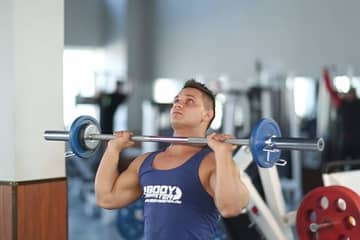 Video Standing Military Press Shoulders
 -
 Video Dumbbell Lateral Raise Shoulders
 -
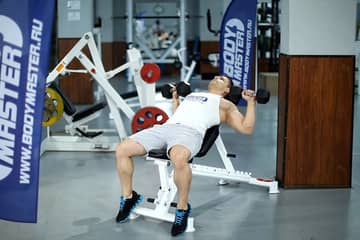 Video Incline Dumbbell Press Chest
 -
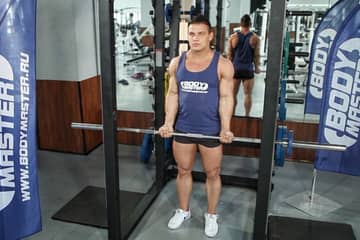 Video Barbell Curl Biceps
 -
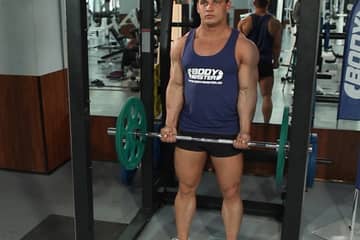 Video Standing EZ Bar Curl Biceps
 -
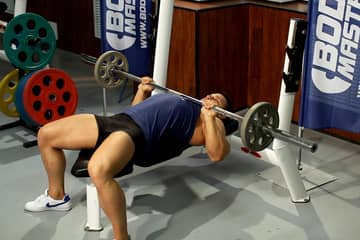 Video Close-Grip Barbell Bench Press Triceps
 -
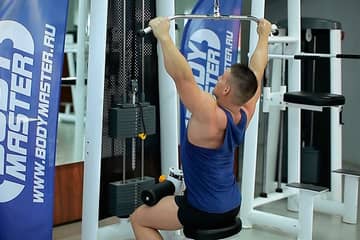 Video Wide-Grip Lat Pulldown Lats
 -
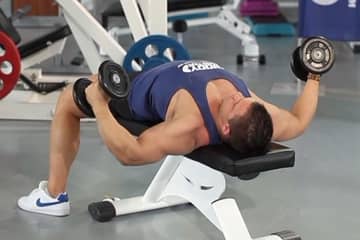 Video Dumbbell Flyes Chest
 -
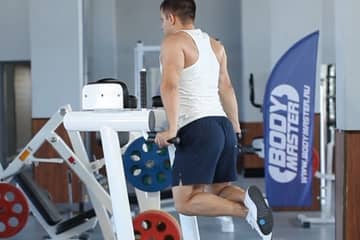 Video Dips — Triceps Version Triceps
 -
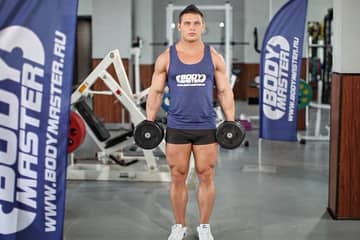 Video Dumbbell Alternate Bicep Curl Biceps
 -
 Video Machine Shoulder (Military) Press Shoulders
 - Video Dumbbell Shoulder Press Shoulders
- Video Dumbbell Bench Press Chest
-
 Video Lying Barbell Triceps Extension (French Press) Triceps
 -
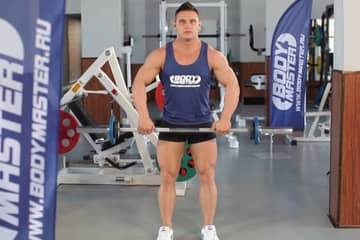 Video Upright Barbell Row Shoulders
 -
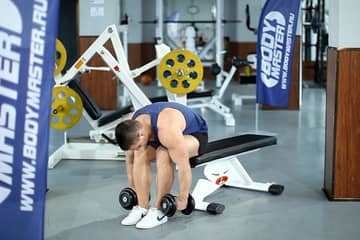 Video Seated Bent-Over Rear Delt Raise Shoulders
 -
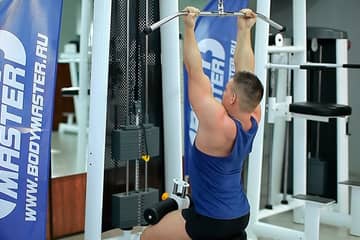 Video Underhand Cable Pulldowns Lats
 -
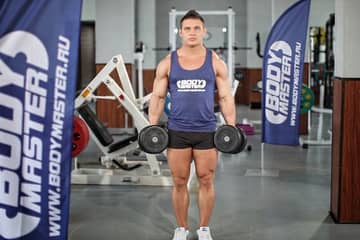 Video Alternate Hammer Curl Biceps
 - Video Close-Grip Front Lat Pulldown Lats
-
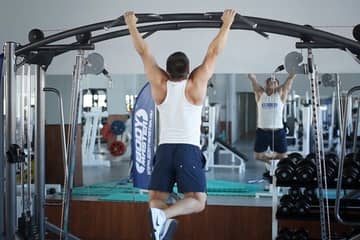 Video Pullups Lats
 -
 Video Chin-Up Lats
No exercises match these filters.
How to train
How the workout is built
Start with an upper-body warm-up of about 5 minutes, then do the exercises in order. Pressing and rowing alternate: while some muscles work, others rest. Biceps and triceps come last. At the gym: horizontal press (a beginner presses dumbbells, with experience a barbell), horizontal row, overhead press, vertical pull (pull-ups with experience), biceps and triceps. At home with dumbbells: dumbbell floor press, one-arm dumbbell row, overhead press, pullover, biceps and triceps. At home with no equipment: push-ups, a back exercise, reverse or close-grip push-ups for the triceps and crunches for the core.
Do “each side” exercises on both sides: a set counts after the right and the left arm. Pull-ups can be done on an assisted machine. At home with no equipment there is nothing to pull on and the lats get almost no load: choose “At home with dumbbells” or get a band or a pull-up bar.
Weight and progression
Train your upper body 2 times a week and leave 48 hours between sessions. A beginner does 3 sets of 10–12 reps in every exercise. Choose a weight that leaves 2 reps in reserve at the end of a set.
With experience the first two exercises get 4 sets of 6–10 reps with a heavier weight and the rest 3 sets of 10–12; pull-ups are also 6–10. At home with no equipment, with experience, you do 4 sets of 12–20 reps. When you reach the top of the rep range in every set, add dumbbell weight or move from “Beginner” to “Experienced”.
Time and rest
The estimated time includes the warm-up and rest between sets. A set takes about 40 seconds, and an exercise done on each side twice as long. Rest depends on the exercise: 90 seconds after presses and rows for a beginner, 120 seconds after the first two exercises with experience and 75 seconds after the rest. After biceps and triceps, and at home with no equipment, rest 60 seconds.
At the gym the workout takes about 40 minutes for a beginner and about 50 minutes with experience, at home with dumbbells about 45 and 50 minutes, at home with no equipment about 25 and 30 minutes. A beginner does 3 sets per exercise, with experience 3–4 sets.
Log weights and sets in the AtletIQ app
AtletIQ saves the weight and reps of every set, calculates your working weight and shows your progress on each exercise.
- Working weight for your goal and fitness level
- Sets, reps and rest in your workout log
- Progress for every exercise
| Workout | Weight | Sets × reps |
|---|---|---|
| 1 | 35.5 kg | 3 × 10 |
| 2 | 40 kg | 3 × 8 |
| 3 | 33 kg | 4 × 12 |
FAQ
What is a good upper body workout?
A good upper body workout has a press and a pull in both the horizontal and the vertical plane, plus biceps and triceps. Presses work the chest, shoulders and triceps, rows and pulldowns work the back and biceps. The generator above builds this set for the place and level you choose.
How often should I train upper body?
Twice a week, with 48 hours between sessions. If you train four days, alternate upper and lower: upper on Monday and Thursday, lower on Tuesday and Friday.
What is an upper body workout with dumbbells?
Choose “At home with dumbbells”. The set is the dumbbell floor press, the one-arm dumbbell row, the overhead press, the pullover, the biceps curl and the triceps extension. A beginner can start with one pair of dumbbells; with experience a range of weights or adjustable dumbbells is more convenient.
Can I train my upper body at home without equipment?
Yes, but your back needs something to pull on: without it the lats get almost no load. At home with no equipment the plan is push-ups, reverse or close-grip push-ups for the triceps, a back exercise and crunches. For rows add a band, dumbbells or a pull-up bar.
What is an upper/lower split?
An upper/lower split divides the week into two kinds of sessions: upper body (chest, back, shoulders, arms) and lower body (legs and glutes). It usually runs four days: upper, lower, rest, upper, lower. Take the upper session from this page and build the lower session in the leg workout generator; the ready four day schedule is in the upper lower split. If three days a week suit you better, take the push pull legs split: the upper body divides into a push day and a pull day.
Upper lower split workout plan · Leg workout · Push pull legs workout plan
How many sets per muscle should I do each week?
For muscle growth most people use 10–20 sets per muscle group per week. In this workout the main exercise gives a muscle 3–4 sets per session; with two sessions a week the sets from presses and rows, where the muscle works as a helper, add up to this range.
AtletIQ app
A workout log with working weight calculation: program, sets and progress on your phone.